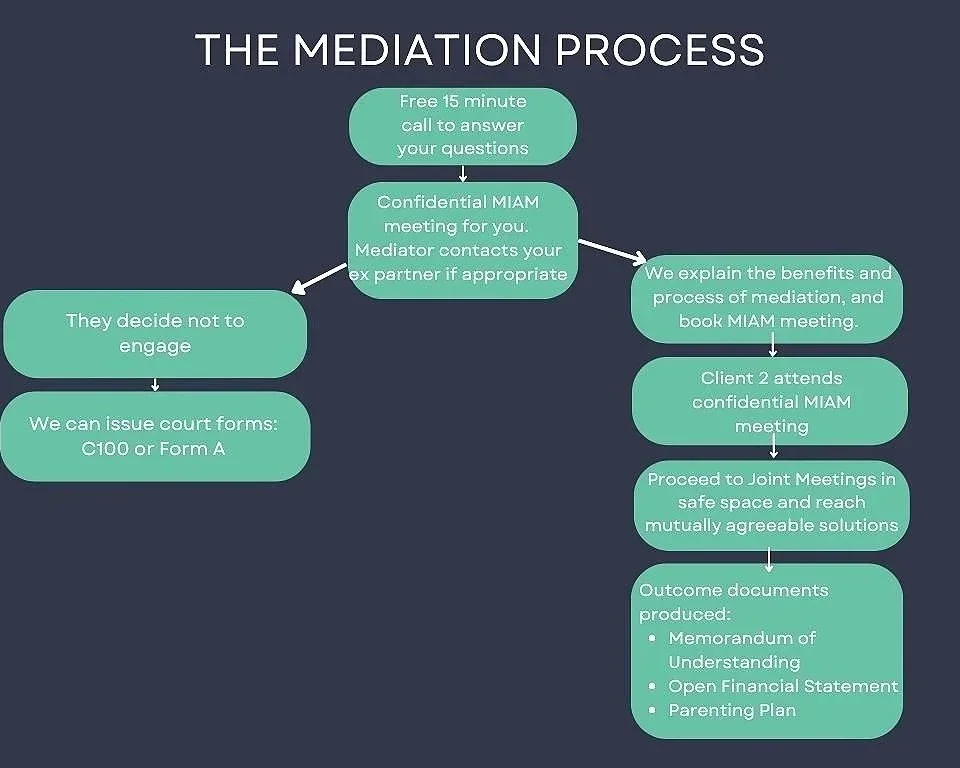
Family Mediation Process
- Step by Step-
Family Mediation is a voluntary process that helps separating or divorcing couples resolve disputes without going to court. Whether you need support around children, finances, or property, understanding how the family mediation process works can help you feel more confident about taking the next step.
Step 1 - MIAM (Mediation Information & Assessment Meeting)
The first stage of family mediation is a MIAM. This is a private meeting with an FMC accredited mediator who explains how mediation works and assesses whether it is suitable for your situation. A MIAM is usually required before applying to the family court.
Step 2 - Joint Mediation Sessions
If mediation is suitable and both parties agree, joint mediation sessions are arranged. These sessions provide a safe, structured space to discuss arrangements for children, finances, or property with the mediator’s support.
Step 3 – Reaching Agreements
When agreements are reached, the mediator records them in clear documents such as a Memorandum of Understanding or Parenting Plan. These agreements can then be reviewed by solicitors if required.
Family Mediation Across the Thames Valley
2Mediate provides family mediation services across the Thames Valley, including Henley, Reading, Maidenhead,Marlow, Oxford, Bracknell, Windsor, Wokingham and High Wycombe. We also offer online mediation for clients across England and Wales.
Common Questions About Family Mediation
Is family mediation legally binding?
Family mediation itself is not legally binding. However, any agreements reached can be made legally binding by asking a solicitor to turn them into a consent order. Mediation allows you to reach decisions collaboratively before formalising them if needed.
How long does family mediation take?
The length of family mediation depends on the issues involved. Some cases are resolved in one or two sessions such as child arrangements, while others involving finances or property may take several sessions over a few weeks or months. Mediation is usually much quicker than going to court.
Do both parties have to agree to mediation?
Yes, family mediation is voluntary, so both parties need to be willing to take part. A MIAM allows each person to explore mediation individually before deciding whether to continue with joint sessions.
Is mediation suitable for children and financial matters?
Yes. Family mediation can help with child arrangements, parenting plans, finances, and property issues. Mediators focus on practical solutions and, where children are involved, ensuring decisions are made with their best interests in mind. Child Inclusive Mediation is available to understand the voice of the child when making arrangements that involve them.
Where children are discussed in mediation we can apply for the £500 Government voucher.
If you’re considering family mediation and would like to understand whether it’s right for you, the next step is to book a MIAM with one of our accredited mediators.